Home » 5 Common Google Ads Mistakes to Avoid

5 Common Google Ads Mistakes to Avoid

{ "@context": "https://schema.org", "@type": "BlogPosting", "@id": "https://www.grizzlymarketing.com/blog/google-ads-mistakes-to-avoid/#blogposting", "mainEntityOfPage": { "@type": "WebPage", "@id": "https://www.grizzlymarketing.com/blog/google-ads-mistakes-to-avoid/" }, "url": "https://www.grizzlymarketing.com/blog/google-ads-mistakes-to-avoid/", "headline": "Google Ads Mistakes to Avoid: 12 Costly PPC Errors That Waste Your Budget", "alternativeHeadline": "The Most Common Google Ads Mistakes and How to Fix Them for Better ROAS", "description": "Discover the most common Google Ads mistakes businesses make and learn how to avoid wasted ad spend, poor targeting, low Quality Scores, and weak conversion performance with actionable PPC optimization strategies.", "image": [ { "@type": "ImageObject", "url": "https://www.grizzlymarketing.com/wp-content/uploads/2025/10/google-ads-mistakes-to-avoid-cover.jpg", "caption": "Google Ads mistakes that reduce campaign performance and waste ad spend", "width": 1200, "height": 630 }, { "@type": "ImageObject", "url": "https://www.grizzlymarketing.com/wp-content/uploads/2025/10/google-ads-keyword-targeting-errors.jpg", "caption": "Keyword targeting and Google Ads optimization mistakes", "width": 1200, "height": 800 } ], "author": { "@type": "Organization", "name": "Grizzly Marketing", "url": "https://www.grizzlymarketing.com/" }, "editor": { "@type": "Organization", "name": "Grizzly Marketing", "url": "https://www.grizzlymarketing.com/" }, "publisher": { "@type": "Organization", "name": "Grizzly Marketing", "url": "https://www.grizzlymarketing.com/", "logo": { "@type": "ImageObject", "url": "https://www.grizzlymarketing.com/wp-content/uploads/2024/01/grizzly-marketing-logo.png", "width": 600, "height": 60 } }, "datePublished": "2025-10-24T09:30:00+01:00", "dateModified": "2025-10-24T11:15:00+01:00", "inLanguage": "en", "keywords": [ "Google Ads mistakes", "PPC mistakes", "Google Ads optimization", "Google Ads strategy", "Paid search marketing", "PPC campaign management", "Google Ads best practices", "Conversion tracking", "Negative keywords", "Quality Score" ], "articleSection": "Google Ads", "wordCount": 2450, "articleBody": "Google Ads can be one of the most profitable digital marketing channels when campaigns are configured correctly. However, many businesses waste significant advertising budgets because of preventable setup mistakes, weak keyword targeting, poor conversion tracking, and low-quality landing pages.\n\nThis guide explains the most common Google Ads mistakes to avoid and how to fix them to improve return on ad spend, increase conversions, and reduce wasted clicks.\n\nWhy Google Ads Campaigns Fail\n\nMany advertisers assume Google Ads automatically generates profitable traffic. In reality, the platform requires accurate campaign structure, keyword intent alignment, proper audience targeting, and continuous optimization.\n\nWithout a clear strategy, campaigns often produce high click costs with minimal conversions.\n\nBusinesses that invest in proper PPC management and campaign optimization typically achieve stronger Quality Scores, lower CPCs, and better lead quality.\n\nLearn more about performance-driven digital advertising strategies at https://www.grizzlymarketing.com/services/google-ads-management/\n\n1. Using Broad Match Keywords Without Control\n\nOne of the most common Google Ads mistakes is relying too heavily on broad match keywords. Broad match can trigger ads for loosely related searches that have little buying intent.\n\nFor example, a company targeting “marketing consultant” could accidentally appear for searches like “marketing degree programs” or “free marketing templates.”\n\nThis creates wasted ad spend and lower conversion rates.\n\nHow to fix it:\n\n- Use phrase match and exact match keywords for higher relevance\n- Monitor the Search Terms Report weekly\n- Add negative keywords continuously\n- Group keywords by intent and service category\n\nA strong keyword strategy improves Quality Score and campaign efficiency.\n\n2. Ignoring Negative Keywords\n\nNegative keywords prevent ads from showing for irrelevant searches.\n\nAdvertisers who skip negative keyword optimization often pay for clicks that will never convert.\n\nCommon negative keywords include:\n\n- Free\n- Cheap\n- Tutorial\n- Jobs\n- Salary\n- Course\n- Internship\n\nBuilding a robust negative keyword list helps eliminate low-intent traffic.\n\nFor additional PPC optimization insights, visit https://www.grizzlymarketing.com/blog/\n\n3. Poor Campaign Structure\n\nMany Google Ads accounts are difficult to optimize because campaigns are poorly organized.\n\nA weak campaign structure makes it harder to:\n\n- Control budgets\n- Optimize bidding\n- Improve ad relevance\n- Analyze performance accurately\n\nBest practices for campaign structure include:\n\n- Separate campaigns by service category\n- Create tightly themed ad groups\n- Match ads closely to keyword intent\n- Use dedicated landing pages for each campaign\n\nProper structure improves click-through rate and conversion performance.\n\n4. Weak Ad Copy\n\nGeneric ad copy often leads to low click-through rates and poor engagement.\n\nYour ads must communicate a clear value proposition and align with search intent.\n\nEffective Google Ads copy should include:\n\n- Primary keywords\n- Unique selling points\n- Trust signals\n- Clear calls-to-action\n- Relevant offers\n\nExamples of strong CTAs include:\n\n- Request a Free Consultation\n- Get a Custom PPC Audit\n- Start Your Google Ads Campaign Today\n\nAdvertisers should continuously A/B test headlines and descriptions.\n\n5. Sending Traffic to the Homepage\n\nOne of the biggest PPC conversion mistakes is directing paid traffic to a generic homepage instead of a dedicated landing page.\n\nUsers who click on an ad expect highly relevant content.\n\nLanding pages should:\n\n- Match the ad message exactly\n- Include strong headlines\n- Focus on one conversion goal\n- Load quickly on mobile devices\n- Display trust elements and social proof\n\nLearn how conversion-focused websites improve lead generation at https://www.grizzlymarketing.com/services/web-design/\n\n6. Not Tracking Conversions Properly\n\nConversion tracking is essential for Google Ads optimization.\n\nWithout accurate tracking, advertisers cannot measure campaign effectiveness or optimize bidding strategies correctly.\n\nBusinesses should configure:\n\n- Form submission tracking\n- Phone call tracking\n- Purchase tracking\n- Lead qualification events\n- Offline conversion imports\n\nGoogle Ads automated bidding relies heavily on clean conversion data.\n\n7. Choosing the Wrong Bidding Strategy\n\nAutomated bidding can improve performance when enough conversion data exists.\n\nHowever, many advertisers use bidding strategies incorrectly.\n\nExamples include:\n\n- Using Target CPA too early\n- Running Maximize Clicks without conversion tracking\n- Setting unrealistic ROAS targets\n\nBefore using automation, campaigns should generate sufficient conversion volume.\n\n8. Ignoring Mobile Optimization\n\nA large percentage of Google Ads traffic comes from mobile devices.\n\nSlow-loading or poorly designed mobile pages create high bounce rates and lower conversion rates.\n\nTo improve mobile performance:\n\n- Compress images\n- Improve page speed\n- Use mobile-friendly forms\n- Reduce unnecessary scripts\n- Optimize above-the-fold content\n\nMobile usability directly impacts Quality Score and conversion rates.\n\n9. Not Using Audience Targeting\n\nAudience segmentation improves targeting precision.\n\nGoogle Ads advertisers should use:\n\n- Remarketing audiences\n- Customer match lists\n- In-market audiences\n- Custom intent audiences\n- Demographic exclusions\n\nCombining keyword targeting with audience data creates more profitable campaigns.\n\n10. Setting and Forgetting Campaigns\n\nGoogle Ads requires continuous optimization.\n\nCampaigns should be reviewed weekly to identify:\n\n- Wasted spend\n- Declining CTRs\n- Search term issues\n- Budget inefficiencies\n- Conversion drops\n\nOngoing optimization improves long-term ROI.\n\n11. Ignoring Quality Score\n\nQuality Score influences ad rank and cost-per-click.\n\nGoogle evaluates:\n\n- Expected CTR\n- Ad relevance\n- Landing page experience\n\nImproving these elements often reduces advertising costs while increasing visibility.\n\nBusinesses can improve Quality Score by:\n\n- Creating tightly themed ad groups\n- Improving landing page relevance\n- Increasing page speed\n- Writing more relevant ads\n\n12. Not Aligning Ads with User Intent\n\nIntent mismatch is one of the biggest conversion killers.\n\nUsers searching for informational content should not receive sales-focused landing pages.\n\nCampaigns should align keywords, ads, and landing pages around a consistent user journey.\n\nExamples:\n\n- Transactional searches should lead to sales pages\n- Informational searches should lead to educational content\n- Local searches should highlight geographic relevance\n\nStrong intent alignment improves both conversion rates and Quality Score.\n\nAdvanced Google Ads Optimization Tips\n\nBusinesses looking to scale Google Ads performance should also focus on:\n\n- First-party data collection\n- Server-side tracking\n- Performance Max optimization\n- Landing page CRO testing\n- Audience layering\n- Attribution modeling\n\nCombining PPC management with SEO creates stronger long-term digital marketing performance.\n\nLearn more about integrated SEO strategies at https://www.grizzlymarketing.com/services/seo/\n\nConclusion\n\nGoogle Ads can generate exceptional results when campaigns are strategically managed.\n\nMost campaign failures are caused by preventable mistakes including poor keyword targeting, weak landing pages, missing conversion tracking, and lack of optimization.\n\nBusinesses that consistently monitor campaigns, improve relevance, and align ads with user intent typically achieve lower acquisition costs and higher returns.\n\nAvoiding these common Google Ads mistakes will help improve lead quality, reduce wasted spend, and maximize long-term PPC profitability." }

Reading time: 8 Minutes

Published on: 19 May 2026

Affordable online marketing

Increase your conversion

Always a personal approach

Tags: SEO & Discoverability

Google Ads can be one of the most effective ways to generate traffic, leads, and sales for your business. When campaigns are set up correctly, they allow you to reach potential customers exactly when they are searching for products or services you offer. This is especially valuable for businesses focusing on online marketing in NYC, where competition is high and visibility at the right moment can make a significant difference.

However, many businesses launch Google Ads campaigns without a clear strategy. As a result, budgets are often spent inefficiently and campaigns fail to deliver the expected return on investment. This is a common challenge in online marketing in NYC, where poorly structured campaigns can quickly lead to wasted ad spend.

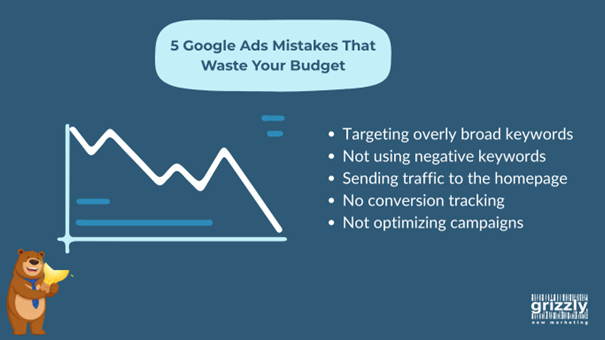
The good news is that most Google Ads problems come down to a few common mistakes and once you recognize them, they are relatively easy to fix. In this article, we highlight five of the most common Google Ads mistakes businesses make and how you can avoid them, especially if you want to improve your results in online marketing in NYC.

1. Targeting Keywords That Are Too Broad

One of the biggest mistakes in Google Ads is targeting overly broad keywords.

Broad keywords may generate a lot of impressions and clicks, but they often attract users who are not actually interested in your product or service.

For example:

Broad keyword

  • marketing

More targeted keyword

  • digital marketing services for small business
  • Google Ads management agency
  • online marketing agency near me

Highly specific keywords tend to attract users with stronger purchase intent, which often leads to better conversion rates.

Instead of focusing on traffic volume, focus on search intent and relevance.


2. Ignoring Negative Keywords

Negative keywords are one of the most important, and most overlooked, features in Google Ads.

They prevent your ads from appearing for irrelevant searches.

Without negative keywords, your ads may appear for searches such as:

  • free services
  • jobs
  • tutorials
  • training courses

These types of searches rarely lead to conversions.

By adding negative keywords, you ensure your budget is spent only on users who are more likely to become customers. Over time, building a strong negative keyword list can significantly improve campaign performance.

3. Sending Traffic to the Homepage

Another common mistake is sending all ad traffic to your homepage.

While a homepage may provide general information about your business, it is rarely optimized for conversions related to a specific search query. Instead, your ads should lead to dedicated landing pages that closely match the user’s search intent.

A good landing page should include:

  • a clear headline that matches the ad
  • a focused message about the offer
  • trust signals such as testimonials or reviews
  • a clear call-to-action

The more relevant the landing page is to the ad and keyword, the higher the chances of converting visitors into leads or customers.

4. Not Tracking Conversions

Many businesses run Google Ads without proper conversion tracking. Without tracking, it becomes nearly impossible to know which campaigns, keywords, or ads are actually generating results.

Conversion tracking allows you to measure important actions such as:

  • form submissions
  • phone calls
  • purchases
  • newsletter signups

Once conversion tracking is in place, you can identify which campaigns deliver the best return on investment and adjust your strategy accordingly. Running ads without tracking conversions is like driving without a dashboard, you have no idea if you’re moving in the right direction.

5. “Set It and Forget It” Campaign Management

Some businesses assume that once a Google Ads campaign is launched, the work is done. In reality, successful Google Ads campaigns require continuous optimization.

Regular improvements can include:

  • adjusting bids
  • testing new ad copy
  • refining keywords
  • updating negative keywords
  • optimizing landing pages

Even small improvements can significantly impact performance over time. The most successful advertisers treat Google Ads as an ongoing process rather than a one-time setup.
Get Better Results

Google Ads remains one of the most powerful digital advertising platforms available today, but success depends on strategy, optimization, and continuous improvement. By avoiding these five common mistakes, businesses can significantly improve campaign performance and get more value from their advertising budget.

At Grizzly New Marketing, we provide internet marketing from professionals in New York City, helping businesses build, manage, and optimize high-performing Google Ads campaigns that generate measurable results. From keyword strategy and campaign structure to conversion tracking and ongoing optimization, our team ensures every dollar of your ad budget works harder. Ready to improve your Google Ads results? Contact our team for internet marketing in New York City and discover how we can help you create smarter, more profitable advertising campaigns.



Recent posts

How to Get the Most Out of Your Google Ads Budget

How to Get the Most Out of Your Google Ads Budget

Many small and medium-sized businesses believe that Google Ads only works if you have a big marketing budget. But that’s not true. With the right strategy, often supported by an experienced online marketing agency, even a modest budget can generate meaningful traffic,...

read more
Grizzly New Marketing is hand-picked by Google as a SMB Partner. Grizzly works closely with businesses to help grow and maximize online campaign performance.

F. van de Peppel, Strategic Partnership Development Team at Google for Northern Europe   Google premier partner logo