What is a good link building strategy?
A good link building strategy is a focused approach to earning valuable backlinks in a natural way. Not by purchasing links, but by being so relevant and helpful that other sites point to you on their own, or by asking for it deliberately in the right places.
Backlinks remain an important signal for Google. Even so, their weight has dropped somewhat in recent years. In 2023, Google itself indicated that links stay important, but that their role is often overestimated and that they’re no longer a top-three ranking factor. The lesson is clear: don’t chase volume, chase quality. One link you earn from an authoritative, relevant site is worth more than dozens of weak links, as long as you can spot strong backlinks.
Start with a solid foundation
Before you work on links, your content and technical setup need to be in order. Link building strengthens a good website, but it won’t rescue a weak one. A link pointing to a thin or slow page does little for you.
So first make sure you have content worth linking to and that your site is technically healthy. Link building is one of the pillars of how you earn search engine rankings, alongside strong content and a solid technical base. Only once that foundation is in place do the techniques below really pay off.
7 techniques for earning backlinks
Below are seven proven link building techniques. The best strategy combines several of them, so your link profile looks natural and varied.
- Create content that earns links
The basis of every link building strategy is content others are glad to point to. This is also called link-worthy content or a link asset. The idea is simple: make something so useful that linking to it becomes an obvious choice.
Formats that often attract links:
- Original research, data, or an industry study. Data that exists nowhere else gets cited readily.
- Comprehensive guides that cover a topic completely.
- Practical tools or calculators that solve a problem.
- Clear infographics or visuals that sum up a complex theme.
Publishing alone isn’t enough. Actively bring your content to the attention of people who’d benefit from it. Without promotion, even the best article often goes unnoticed.
- Write guest posts on relevant sites
Guest posting means writing an article for another website in your field, with a natural link to your own site inside it. It earns you a backlink and positions you as an expert in front of a new audience.
The quality of the platform determines the value. A guest post on a respected industry portal with real traffic carries more weight than ten contributions on sites that exist only to place links. Write the article so it’s valuable to that platform’s readers even without the link. Editors see right through a piece that was written only for the link.
- Use broken link building
Broken link building means tracking down broken, dead links on other websites and replacing them with a link to your own content. You help the site owner with a fix and earn a backlink at the same time.
Here’s how you go about it:
- Search relevant sites in your industry for links that no longer work. There are tools that find broken links for you.
- Make sure you have content that’s a good replacement for the missing page.
- Email the site manager, kindly point out the broken link, and offer your page as an alternative.
This technique works because you give something back. You solve a real problem on the site.
- Put digital PR to work
Digital PR is the deliberate creation of newsworthy content, such as data or a striking study, and offering it to journalists and editors. If they pick it up, that earns you links from authoritative media sites. In Europe, this is often the most sustainable way to earn strong links.
Think of a study with surprising numbers, a response to a current topic in your industry, or a unique angle the press can use. The key is a story an editorial team wants to run on its own. Well-executed digital PR earns you not just links, but also brand awareness and referral traffic.
- Turn brand mentions into links
Your brand gets mentioned online without a link attached. Unlinked mentions like these are opportunities ripe for the taking. The site is already writing about you, so a link is a small step.
Search regularly for your company name and the names of your products. When you find a mention without a link, reach out to the author and kindly ask whether they’d add one. Because the content is already about you, the odds of success are high.
- Build local links
Local links come from sites tied to your region or immediate area. For businesses with a local or regional audience, they’re extra valuable, because they combine relevance and local authority.
Opportunities for local links:
- Industry directories and reliable business listings.
- Local news sites and regional platforms.
- Sponsoring an event, club, or charity nearby.
- Partnerships with suppliers, partners, or trade associations that point to you.
- Learn from your competitors’ backlinks
Your competitors show you which sites in your industry are willing to link. By analyzing their link profile, you’ll uncover opportunities that are within reach for you too.
Use a backlink tool to see which websites point to your competitors. If you spot an industry directory, a trade blog, or a platform where you’d fit as well, you know where to knock. You don’t have to reinvent the wheel. You simply follow the trails others have already blazed.
Which techniques are better to avoid?
Not every way to get links is a smart one. Some techniques pay off in the short term but put your site at risk in the long run.
Steer clear of these approaches:
- Buying links in bulk. This counts as unnatural links and can lead to a penalty.
- Link farms and private blog networks (PBNs). Google keeps getting better at recognizing networks that exist only to place links.
- Swapping links en masse. A few mutual links is normal, but at scale it looks contrived.
- Spam links in comments and forums. These rarely count and look unnatural.
The common thread: anything whose goal is to mislead Google instead of helping the reader is risky. You earn sustainable links, you don’t buy them.
How to build a link building strategy step by step
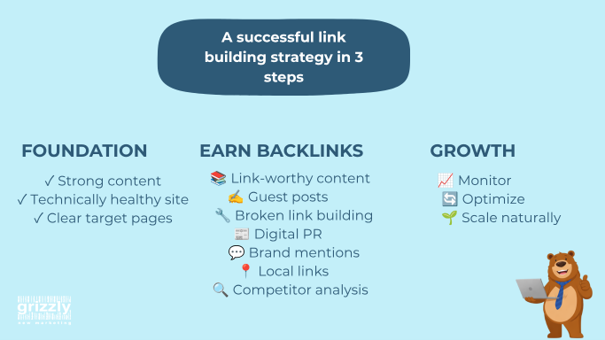
You move from loose techniques to a real strategy with a fixed process. These six steps keep your approach focused and measurable.
- First check that your content and technical setup are in order.
- Decide which pages you want to strengthen and for which keywords.
- Analyze your own link profile and that of your competitors.
- Choose a mix of techniques that fits your market and budget.
- Execute consistently. Favor gradual, natural growth over a sudden spike.
- Monitor your backlinks and adjust based on what works.
Link building isn’t a one-time job, but an ongoing process. The sites at the top almost always keep working on their link profile.
Earning pays off more than buying
A good link building strategy combines several techniques, builds on a solid foundation, and always chooses quality over numbers. Link-worthy content, guest posting, broken link building, digital PR, brand mentions, and local links complement each other into a natural link profile. That takes time, but the result holds up, even after a Google update.
Want to earn backlinks without unnecessary risk, or do you lack the time to work on it structurally? As an online marketing agency, we help businesses build a link profile that delivers lasting results. Want to learn more about link building, or have your opportunities reviewed first? Feel free to schedule a free consultation.
Frequently asked questions
Does link building still work? Yes. Backlinks remain an important signal for Google, though their weight has dropped somewhat. The emphasis now falls more heavily on quality and on links you earn rather than buy.
How long does it take before link building shows results? Count on months, not days. Links have to be noticed and valued, and a natural profile grows gradually. Consistent effort delivers the most over the long term.
Are you allowed to buy backlinks? Paid links at scale go against Google’s guidelines and can lead to a penalty. Earned, editorial links are safer and more sustainable.
How many backlinks do I need? There’s no fixed number. A few strong, relevant links do more than dozens of weak ones. Quality carries more weight than quantity.
What’s the difference between link building and link earning? With link earning, you earn links purely on the strength of good content, without asking for them. Link building is the broader term and also includes active techniques like guest posting and outreach.


 Reading time: 7 Minutes