What is a quality backlink?
A quality backlink is a link from a relevant, trustworthy website that sits in a natural spot within valuable content and points to your page in good faith. Google reads a link like this as a recommendation. It’s a sign that another site considers your content worth mentioning.
Backlinks are one of the most important signals Google uses to gauge a page’s authority. Even so, not all links count. A link only truly counts when it comes about in a credible way. A spontaneous mention in a strong article is something entirely different from a purchased link buried among dozens of others. Quality isn’t about the number, then, but about the context and the source.
Why quality beats quantity
With backlinks, quality carries more weight than quantity. One link from an authoritative, relevant site often does more for your rankings than dozens of links from weak or random websites.
That’s because Google keeps getting better at recognizing unnatural links and either ignores them or discounts their value. Anyone buying links at scale risks having those links count for nothing. In the worst case, a penalty follows for an unnatural link profile. So you don’t build strong backlinks through volume, but through trust. The question isn’t “how many links do I have?” but “which sites vouch for me credibly?” Backlinks are an important part of how you earn search engine rankings, alongside good content and a technically sound website.
How do you recognize a quality backlink? The 6 traits
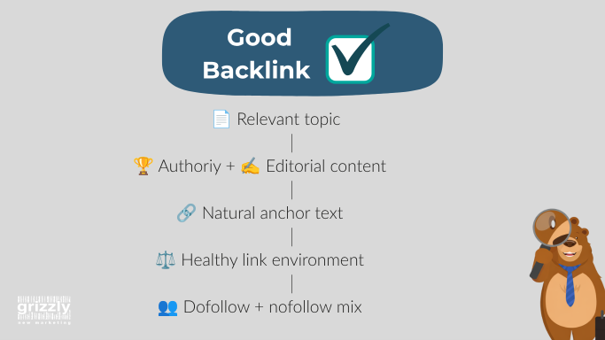
You can spot a strong backlink by six traits. Run through them and you’ll quickly know whether a link is really helping your site.
- Topical relevance
A relevant backlink comes from a website or page that fits your topic in terms of subject matter. Say you run a webshop for sustainable clothing. Then a link from a blog about sustainability is far more valuable than a link from a site about used cars.
Google looks at the context surrounding the link. When the topic of the referring page logically connects to your page, the link carries more weight. Relevance works on two levels: that of the entire website and that of the specific page the link appears on. Both should fit your theme.
- Authority and trust of the source
The more authoritative the referring website, the more the link counts. A link from an established news outlet, a research institute, or a recognized authority in your industry has more effect than a link from an unknown, small site.
You can recognize authority by a few signals. The site has real organic traffic, publishes substantive content, and has built a credible profile of its own. A backlink from a source like that works as a sincere vote of confidence. Note that authority isn’t the same as a high number in a tool. More on that further down.
- Placement on the page
A link in the middle of relevant, editorial content is more valuable than a link in the footer, the sidebar, or an author bio. A link woven naturally into good writing reads like a genuine recommendation.
When a link appears on every page of a site at once, for example in the footer, that quickly looks unnatural. A link that disappears far down the page among dozens of others adds little too. The best spot is near the top or in the middle of a substantive page, at a point where the link genuinely helps the reader.
- The anchor text
The anchor text is the clickable text of the link. It should be natural and descriptive and fit the page it points to. Good anchor text makes clear in advance what the reader can expect after the click.
A healthy link profile has variety in its anchor text. Think of your brand name, the bare URL, and descriptive phrases mixed together. When the exact same keyword is used as anchor text every time, that looks forced. Over-optimization like that is actually a signal of manipulation to Google.
- Dofollow or nofollow
A dofollow link passes authority to your site. A nofollow link does not, in principle, because an attribute is attached to the link that asks search engines not to follow it.
Even so, nofollow doesn’t mean “worthless.” Links like these bring in traffic, raise your brand awareness, and belong to a natural profile. A profile made up only of dofollow links actually looks unnatural. A healthy mix of dofollow and nofollow is normal and desirable.
- The link environment and how the link came about
An earned, editorial link from a healthy environment is strong. A purchased link surrounded by spam is weak and risky. So don’t just look at the link itself, but also at the company it keeps.
When the source site links out to shady topics like gambling sites or other spam, that colors the judgment of your link negatively. Ask yourself, too, how the link came about. Was it earned through good content or a real partnership? Or was it simply bought? Earned links fit Google’s guidelines. Purchased links at scale count as unnatural links and can turn against you.
Domain authority: a handy tool, not a Google score
Domain authority is an estimate from a third-party tool, not an official Google score. The best-known examples are Domain Authority (DA) from Moz and Domain Rating (DR) from Ahrefs. Both run from 0 to 100 and give an indication of a link profile’s strength.
Important to know: Google does not use DA and DR as a direct ranking factor. They’re tools that SEO specialists came up with to compare sites quickly. They’re useful as a first indication, but you can’t rely on them blindly. A high score is also manipulable to a certain extent. A site with an impressive number but hardly any organic traffic is therefore a warning sign.
So use domain authority as one of several signals. Always combine the number with relevance, with the site’s real traffic, and with the quality of its content. That keeps you from overrating a link based on a number alone.
How to evaluate a backlink step by step
Want to size up a link fast? Run through this checklist. If you answer most of the questions with yes, you’re probably dealing with a quality backlink.
- Does the referring site fit your topic in terms of subject matter?
- Does that site have real organic traffic and a credible profile?
- Is the link in editorial content, and not in a footer or sidebar?
- Is the anchor text natural and descriptive, without the exact same keyword every time?
- What kinds of sites does the source link out to? Is the environment clean?
- Is the link earned or editorially placed, and not bought among spam?
- Would you value this link even if SEO didn’t exist?
Common mistakes when evaluating backlinks
Even people who focus on quality slip into a few traps easily. These five come up most often.
Looking only at numbers. A hundred weak links don’t outweigh a handful of strong ones. Volume says little on its own.
Fixating on domain authority. A high number without traffic or relevance is misleading. Always look at the full picture.
Over-optimizing anchor text. Using the same keyword as the anchor every time looks forced and works against you.
Chasing quantity with purchased links. Bulk links rarely deliver lasting value and bring risk with them.
Ignoring relevance. A link from an authoritative but completely unrelated site counts far less than many people think.
Quality over quantity pays off
In the end, you recognize quality backlinks by the sum of relevance, authority, placement, anchor text, link type, and the way the link came about. One link that checks all these boxes is worth more than a handful that don’t. Anyone who judges their link profile on quality builds a position that holds up.
Do you find it hard to weigh links objectively, or do you want to strengthen your link profile structurally? As an online marketing agency from NYC, we assess every potential link against these criteria before it’s placed. Want to learn more about outsourcing link building, or have your own profile reviewed first? Feel free to schedule a free consultation.
Frequently asked questions
How many backlinks do I need to rank? There’s no fixed number. Quality matters more than quantity. A few strong, relevant links usually do more for your rankings than dozens of weak ones.
Are nofollow links worthless? No. A nofollow link generally doesn’t pass authority, but it does bring traffic and brand awareness. On top of that, a healthy mix of dofollow and nofollow belongs to a natural link profile.
What is a good domain authority? There’s no magic number. Domain authority is relative and varies by industry. Alongside the number, always look at the organic traffic, the relevance, and the quality of the site.
Can bad backlinks harm my website? Yes. Unnatural or spammy links can pollute your profile and, in extreme cases, lead to a penalty. You can have links like these reviewed and, if there’s no other option, disavowed.
How do I check my own backlinks? Google Search Console shows you which sites link to you. A backlink tool gives you more detail about the source, the anchor text, and the link type, so you can judge the quality.


 Reading time: 5 Minutes