How Does Content Pruning Work in Practice?
Content Pruning always starts with analysis. The goal is not to “clean up just to clean up,” but to understand which pages genuinely contribute to your website and which don’t.
We evaluate questions such as:
- Does this page receive organic traffic from Google?
- Is it ranking for relevant keywords?
- Does the content match search intent?
- Does the page contribute to conversions or other business goals?
- Is the content still current and high quality?
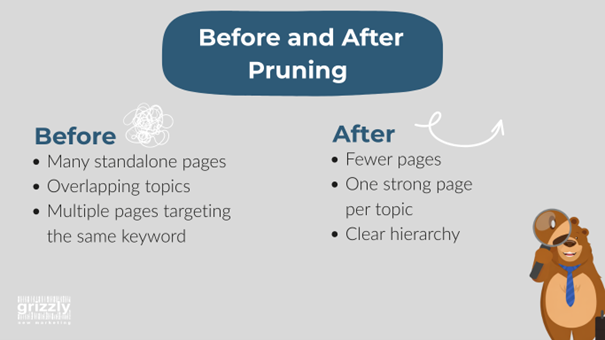
Based on these insights, strategic decisions are made. Sometimes a page adds little value. In other cases, multiple pages cover nearly the same topic. Instead of keeping everything, we consolidate content into one strong, clearly structured page.
In practice, Content Pruning may involve:
- Merging content
- Updating outdated information
- Repositioning pages within the site structure
- Implementing redirects (only removing pages in rare cases)
The result is a website with less noise, more focus, and stronger signals for search engines.
A professional SEO agency will always prioritize clarity and authority over sheer content volume.
Why Is Content Pruning Important for SEO?
Google increasingly evaluates websites as a whole. That means not only your best-performing pages matter, your weaker ones do too.
Pages with thin content, outdated information, or unclear focus can negatively impact the overall performance of your site.
Many websites contain pages that:
- Attract little to no traffic
- Don’t align with search intent
- Have no clear role within the site
- Overlap with other pages
When these pages remain untouched, confusion arises, for both Google and users. Content Pruning removes that confusion and raises the overall quality standard of your website. Stronger pages perform better when they are not competing internally. For NYC businesses investing in search engine optimization, this level of clarity is essential to compete in a saturated market.
Content Pruning and Keyword Cannibalization
A common issue on larger websites is keyword cannibalization. This happens when multiple pages target the same topic or keyword, competing against each other instead of reinforcing one another.
You may recognize this if:
- Multiple URLs appear for the same keyword
- Rankings fluctuate constantly
- None of the pages rank particularly high
When this happens, Google struggles to determine which page provides the best answer. Authority gets divided across multiple URLs, preventing any single page from becoming strong. The solution is rarely to simply delete pages. Many of these pages already hold value: traffic, internal links, or external backlinks. Instead, we often merge content into one authoritative page and implement proper redirects. This preserves link equity and ensures both users and search engines understand which page should rank. For businesses focused on local SEO in New York City, consolidating location-based content properly can significantly improve local rankings.
When Is Content Pruning Necessary?
Content Pruning is especially relevant for websites that have existed for several years and accumulated large amounts of content.
A key signal:
Your website has many indexed pages, but relatively low organic traffic. In other words, Google knows your pages exist, but barely shows them in search results.
Other signs include:
- SEO performance stagnates despite publishing new content
- Multiple pages cover the same topic
- It’s unclear which page serves which purpose
In these cases, adding more content is rarely the solution. Creating structure and focus typically produces far better results than publishing yet another blog post.
How We Approach Content Pruning
For us, Content Pruning is not a one-time cleanup task, it’s part of a broader strategic approach.
Rather than removing pages retroactively, we work proactively. By defining clear topics, search intent, and page roles upfront, we prevent unnecessary or overlapping content from being created in the first place. We don’t optimize page-by-page, we look at the bigger picture.
Often, we see multiple pages with similar themes. That doesn’t improve rankings; it causes fragmentation. In those cases, we strategically combine keywords into one well-structured, high-authority page. This focus-driven approach builds scalable websites where Content Pruning later becomes minimal. As a results-oriented SEO agency, we prioritize long-term authority over short-term content volume.
The Role of an SEO Content Audit
A thoughtful Content Pruning strategy always starts with an SEO content audit. Without data and structural analysis, informed decisions are impossible.
During an audit, we evaluate not only performance metrics but also:
- Content relationships between pages
- The internal linking structure
- Topic clusters and authority signals
- Competitive positioning
For NYC companies active in search engine optimization or targeting competitive local SEO in New York City markets, this analysis often reveals significant untapped potential.
Each page is assessed individually: Should it be optimized, merged, repositioned or left as is? Content Pruning then becomes a logical step in website optimization, not a risky experiment.
How Content Pruning Fits Into Website Optimization
Content Pruning never stands alone. It affects content, SEO, and structure simultaneously.
By creating focus first, search engines can better understand and index your most important pages. It also strengthens internal linking and builds clearer thematic authority.
Future content becomes more effective as well. New pages support existing ones instead of competing with them.
What Results Can You Expect?
Websites that strategically implement Content Pruning often experience:
- More stable rankings
- Improved performance of existing pages
- Stronger topical authority
- Clearer focus on core subjects
Not because they have more content, but because each page serves a defined purpose.
Choose Relevant Content Over More Content
Content Pruning proves that SEO is not about publishing as many pages as possible. It’s about making clear, strategic decisions.
Not every page needs to exist. But every page that does exist must add value. By critically evaluating what your website truly needs, and what it doesn’t, you ensure your content works for you instead of against you.
If you’re unsure where your biggest opportunities lie, working with an experienced SEO agency can help you identify weaknesses and strengthen your overall strategy, whether your focus is broad search engine optimization or highly targeted local growth. Request an SEO content audit and discover how strategic Content Pruning can improve your online performance.


 Reading time: 9 Minutes